Signage and color contrast
Within signage & wayfinding design the way of color and contrast are important factors to effectively communicate a message. Colors have different meanings and work in various ways in contrast together. This article will explain the meaning of color and will show various examples of contrast.
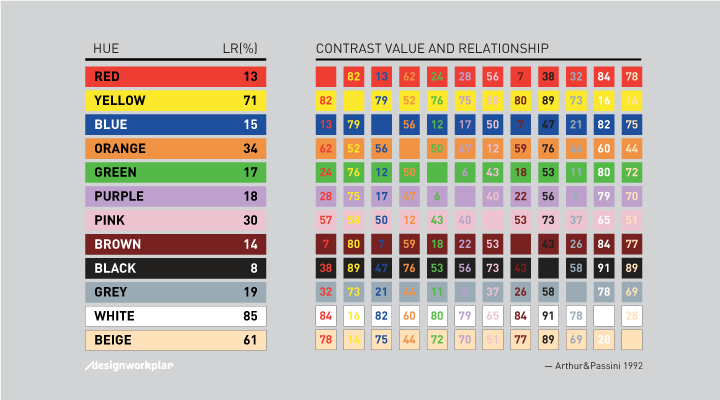
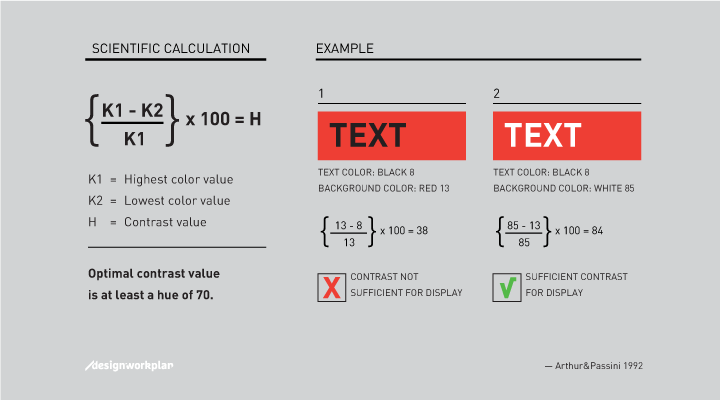
Contrast between the foreground and background is one of the most important factors for the ease of reading. If coloured text is used on a bright background the contrast will be weak, for optimal contrast results is white text against dark colored backgrounds. In signage & wayfinding design color is the combining factor to harmonize the sign with the environment. Color programs will distinguish signs from each other and can offer an indication of the message without having to be able to understand the language of the sign.
Basics of color groups: Color wheel
Swiss painter and designer Johannes Itten created a color wheel that is a organization of 12 color hues around in a circle showing relationships between the colors. The colors are presented in the following way:
- Primary colors: Blue, red & yellow
- Secondary colors: Green, orange & violet
- Complementary colors: Red–orange, red–violet, yellow–orange, yellow–green, blue–violet & blue–green.
Most color wheels are based on Goethe’s Theory of Colours, the first systematic study of the physiological effects of color (1810). His observations on the effect of opposed colors led him to a symmetric arrangement of his color wheel, “for the colours diametrically opposed to each other… are those which reciprocally evoke each other in the eye.” (via wikipedia)
The color wheel can be a basis for the color scheme for the design you are about to create. Using the wheel you can easily find the combinations between the colors and see what works best. See the opposite colors and combine the colors into a signage color scheme.
Meaning of color
Black is not actually a color but is often used as background surface in sign design, black can offer a attraction in a visual crowed environment. Meaning of black: Black is associated with power, elegance, formality, death, evil, and mystery.
White as background surface has the ability to absorb dark lettering into its surroundings, in order to make white work good in sign design use a matted surface with glossy lettering. Meaning of white: White is associated with light, goodness, innocence, purity, and virginity. It is considered to be the color of perfection.
Red is a signal color, as background red is mostly used for warning signs. Meaning of red: Red is the color of fire and blood, so it is associated with energy, war, danger, strength, power, determination as well as passion, desire, and love.
Yellow in sign design is used as background, yellow has a function of sending out a message and works good in a spacial environment, it stands out. Meaning of yellow: Yellow is the color of sunshine. It’s associated with joy, happiness, intellect, and energy.
Blue is one of mankind favourite color, but for design blue will not always have the best results, try using various hues of blue to find the best matching results. Meaning of blue: Blue is the color of the sky and sea. It is often associated with depth and stability. It symbolizes trust, loyalty, wisdom, confidence, intelligence, faith, truth, and heaven.- Resource the meaning of color further on this page.
Black background
In sign & wayfinding design contrast will let you read the signs at ease. Below you will find various examples of good and bad contrast in order to make the design work.
With a black background the lettering tends to stand out more onto to background than with other colored backgrounds. Black is one of the few surfaces that lets other colored text work great together. Beware of too small lettering with too high contrast (white lettering), these will lead to less legibility of the text because of overwhelming background. With large lettering white on black works great. Also yellow on black is a good combination.
Advisable work areas: Airport signage, office building signs, visual overwhelming environments, hotel signage, indoor usage.

White background
White background surface gives the most workable combinations, but beware of that white can absorb its environment. Black lettering tends to be squeezed into the background making it hard to read. Lower contrast lettering gives better results like blue, orange and red.
White backgrounds can be used specific sign projects where design plays a bigger part than the actual wayfinding. For instance using silver lettering on a white background can give fabulous results, due the shadow of the silver lettering the text becomes readable on the white surface.
Advisable work areas: Museum signage, office building signs, pylon signage, retail signage, hospital signage, indoor & outdoor usage.

Yellow background
Yellow background works best in visual crowded environments, for architectural and psychological factors yellow is often used. Yellow with black lettering sends out a clear information message which is needed in such an environment. Using yellow also makes in easy to use orange, red and green which all work great together in a signage system.
Yellow is a much used background color for airport signage, originally started by Paul Mijksenaar for Schiphol Airport signage, nowadays yellow is seen in many airports around the world. Yellow in combination with black lettering gives ease to read and at the same time a clear information message in its surroundings.
Also for traffic signs yellow works good as background color in combination with black lettering. In a outdoor situation, yellow stands out from its background giving a clear message. In many European countries yellow is chosen as background color.
Advisable work areas: Airport signage, road signs, public spaces, indoor & outdoor usage.
Red background
Red is often used for warning signs, red sends out a signal of warning, danger. Many of the warning signs consist of a red background with yellow or white lettering, by using pictograms as warning the signs are multi-language and don’t need explanation, even if you cannot read the text.
Red is a very powerful color which stands out in a visual crowded environment. I have seen various other signs produced with red but in my opinion red is a signal color. Works great with black, white and yellow lettering.
Advisable work areas: Warning signs, public spaces, indoor & outdoor usage.

Blue background
Blue is one of mankind favourite color, as is represents sky, heaven, trust and faith. The color blue is good recognized with white lettering as information sign. In the Netherlands all highway signs are with blue background as well as the railway signs.
To use blue in sign systems beware of create enough contrast in order to make the signs work best. For instance with light blue a higher contrast lettering will be needed such as black and for dark blue white lettering will work best.
Advisable work areas: Highway signs, railway signs, hotel signage, retail signage, public spaces, indoor & outdoor usage.

Purple background
Purple will not be your direct usage of background color for signage color systems, but purple is a fashion color which is asked by clients to use. Purple works great with lighter colored lettering such as white or yellow.
Purple can be used in signage systems but beware of its architectural environment, as purple is a very powerful color it can easily fade into the background making the sign unreadable.
Use the color wheel to create the hue of colors around the color purple. Purple represents royalty and spirituality, it was Pantones color of the year 2008. PANTONE® 18-3943 BLUE IRIS.
Advisable work areas: Museum signage, hotel signage, retail signage, indoor usage.
Silver (brushed) background
Silver (metal) is an often used color as background in sign systems. With metal signs you are able to gain a robust look & feel for the signage system. Metal has a different surface when looking at it from different angles, making it not always a good contrast with the lettering.
On a silver background almost all colors work well, even white. In future articles I will go deeper into using silver as background.
Metal signs are frequently used in office signage, with black lettering it will create a very stylish look and feel.
Advisable work areas: Office signage, nameplate design, public spaces, indoor & outdoor usage.

Typography & color contrast
Not only is the contrast important also the chosen typeface will make the difference in a good or bad sign. When using too bold weighted typefaces the text will look like its expanding of the sign, when using too light weighted typefaces the text will fall back into its background. Medium or Regular weights are usually the best options to choose for a good and readable sign.
Please share your thoughts
What do you find the most attractive/readable colored background?
Looking forward discussing about colors & signs! Thank you in advance.


35 Responses to “Signage and color contrast”
Rob Chant
February 23rd, 2009
Very useful post, thanks
It may be worth noting that meanings and associations we have with colour are very dependent on culture. For a Chinese person, for example, the associations, with, say, the colour red, may be very different than our own.
1.
Frank
February 23rd, 2009
Wow! Nice article. Never noticed al those colours in the signs around me, but now I probably will.
2.
Vincent
February 23rd, 2009
Well written article, I will use this information to communicate my choices for colors.
3.
Sander Baumann

February 23rd, 2009
Thanks Rob Chant - for your comment. You are totally correct, all colors have different meanings in different cultures.
Meaning of red
Source.
This is a photo of a typical warning sign (US/European)


Here is a photo of a Chinese warning sign
Although the Chinese photo is not very sharp you can still notice the red circles around the prohibited icons. Therefore I strongly believe for warning signage, red is the color used all over the world. Thanks again for your comment, appreciated!
Thanks Frank & Vincent - for your comments, very appreciated.
4.
Николай Громов (nicothin)
February 23rd, 2009
tag cloud at this site demonstrates the bad contrast of colors.
it (in a cloud of tags) is used for ranking the font size and color. tags used by a small amount of time, almost to merge with the background (very difficult to read them).
5.
Sander Baumann

February 23rd, 2009
Hi Николай Громов (nicothin) - Thank you for your insight, I believe you have a point there, a bit offtopic to the article but comment noted.
6.
Rob Chant
February 23rd, 2009
Sander, thanks for the feedback. You’re probably right about red being a fairly universal warning colour.
Regarding your tag cloud, I think it works well how it is now. Obviously the lesser used tags do fall into the background, but surely that’s the point?
7.
Jin
February 23rd, 2009
I’m glad Rob brought up the culture differences here. Red in China, is as you described in your comment. However red is never used for writing a person’s name. Because in the old times, the warden would write names of prisoners who are to be executed in red.
8.
Josef Go-Oco
February 23rd, 2009
Very useful post, thanks! I’m doing okay with my blog – I just don’t have time to make content because of school stuff, and I’m planning on buying hosting and domain, so I’m also withholding.
Anyway, I believe cultural differences on the interpretation of color can be dissolved easily with multicultural waves about us, familiarizing generations with the global ‘standard’, thereby reinforcing their roles as standards. Such is the effect of globalization.
9.
Rob Chant
February 23rd, 2009
“cultural differences… can be dissolved easily with multicultural waves about us”
It would be a sad, sad day that this comes to pass.
10.
Josef Go-Oco
February 24th, 2009
Very much so. Out of the topic, but if a nation with a weak national identity – or one that has not found its own identity – has been exposed to a culture of multiculturalism, then I’m afraid it would lose its ground and be afloat with its hodgepodge of cultures.
11.
Mark Denton
February 25th, 2009
Nicely done, Sander. I like the discussion of what the different colors connote. I think we often take this into consideration in an intuitive manner when designing signage systems, but I don’t think I have really seen the meanings spelled out like this before.
You’re right about yellow being a more common background color in Europe. I don’t see it used nearly as much here in the U.S.
12.
Sander Baumann

February 25th, 2009
Thank you all for the input, much appreciated!
13.
tulsa signs
February 27th, 2009
The discussion on color (hue) is interesting.
However, the primary importance of color on a sign is its value in relation to the background.
All colors should be converted to their respective gray scale so their actual value can be seen.
In most sign design, the primary copy should have the greatest value contrast to its background.
(light on dark, dark on light)
The secondary copy should have less of a value contrast.
Just look at any landscape image that shows mountains in the distance.
There is a foreground, middle ground and background.
Signs should be the same.
14.
kovshenin
February 27th, 2009
Cool, thanks this may come in handy…
15.
Jenny Pilley
March 23rd, 2009
It is interesting to see how this can relate to web designs. The colours and contrasts can make different company trades more susceptible to use some colours with others. With the different text on the plain colours it is easy to which colours go together and those that should be avoided. Excellent information.
16.
Hendry
March 29th, 2009
Dear All,
My name is Hendry Soetardjo Nanuru. I am a 4th year student in Visual Communication Design at Institut Teknologi Harapan Bangsa, Bandung - Indonesia. Currently I am writing my thesis to finish my study in Visual Communication Design.
I am really interested in Dutch graphic design. The simple form, great concepts, free expression and exploration, make Dutch design good. So I took Dutch design as the topic of my thesis.
The topic of my thesis is about the use of “Colors in Dutch Design”.
I would like to know why many Dutch designers are really confident to use colours in their design? Maybe there are also other reasons that make Dutch designers are confident to use color.
Would you like to advice me, which books are related with my topic? It is quite difficult for me to find information about a good books. I bought already some books; Dutch Graphic Design (Century of innovation), False Flat, and Design van de 20ste eeuw, but there is still not enough explanation about “colour in Dutch design”.
I appreciate your help, and thank you in advance.
Kind regards,
Hendry
17.
Javier
March 29th, 2009
This is good material very useful, thanks
18.
Hendry
March 30th, 2009
Hi Javier,
Thank you.
Are you dutch? Do you know any ducth people here, and may I make an interview with you or them by skype?
Thank you for your help.
Kind regards,
Hendry
19.
Sander Baumann

March 30th, 2009
Thank you Hendry Soetardjo Nanuru - for your comment. I will send you an email so when can discuss more about color and Dutch designers.
20.
Javier
April 6th, 2009
hello hendry thank you very much send me your questions to my email.
21.
Ngoc Thuy
April 12th, 2009
thanks a lot, they are really clear and helpful for my design course ^^
22.
Hendry
April 14th, 2009
Hi all,
Any dutch designer here? Is it possible if I make an interview with one of you guys?
I need your help to finish my thesis.
Please just let me know.
Thank you in advance.
Regards,
Hendry
23.
Jonathan
May 14th, 2009
Sander,
Your article is a good start for a serious conversation.
As noted by other readers, the colour meanings you describe are somewhat arbitrary and very generic. I realise you were aiming to sum up more complex issues, but I believe that in the area of wayfinding and signage design generalised advice can lead to frustration and even accidents. When describing colour contrast and colour meaning, it is important to speak of ‘a blue’ and not just of ‘blue’, for example Navy blue or Marine blue, both of which elicit quite a different emotional response and achieve a different colour contrast with other colours.
Certain colours have explicit meanings and uses. These are prescribed by international and local standards and building codes. For example refer to ISO 7010:2003.
White background tends to reflect light and generate glare, which diminishes legibility, even when using matt surface finish. Unless you are using a combination of text size and thickness that compensates for this, it is advisable to avoid white background.
When discussing which colours to use, one must consider the physical context of the sign, as you suggest yourself. Not only do you need to have good contrast between text and background colour, but also sign background and the environment in which it is placed, or you start having people bumping into sign structures.
Another crucial aspect to consider in the context of ‘signage and colour contrast’ is colour-blindness. A colour combination that may seem to have sufficient contrast for people with full colour vision may not be suitable for all.
24.
darshini
May 28th, 2009
jonathan,
i am content and motivated after reading your write up.
i agree that there cannot be any generalization in design or design principles.
i am a space designer working on a signage project for India Habitat Centre, New Delhi, India.
i am equipped with design skills but need whole lot of info on “Signage design” and preferably the design process that follows.
does everything at the end of the day boil down to - “what suits the eye of the viewer”
25.
AKY
May 29th, 2009
Very helpful. Thanks!
26.
Игорь Меньшиков
June 1st, 2009
Грамотно написано, но мне кажется, что автор что-то не договаривает
27.
Muripshaka Yibis
September 16th, 2009
Thougtfully and practically written! I am really impressed and this article has added alot to how much i know of colour application in practical usage.
28.